
Alarm as infant HIV infections spike in Wajir
Source: The Standard
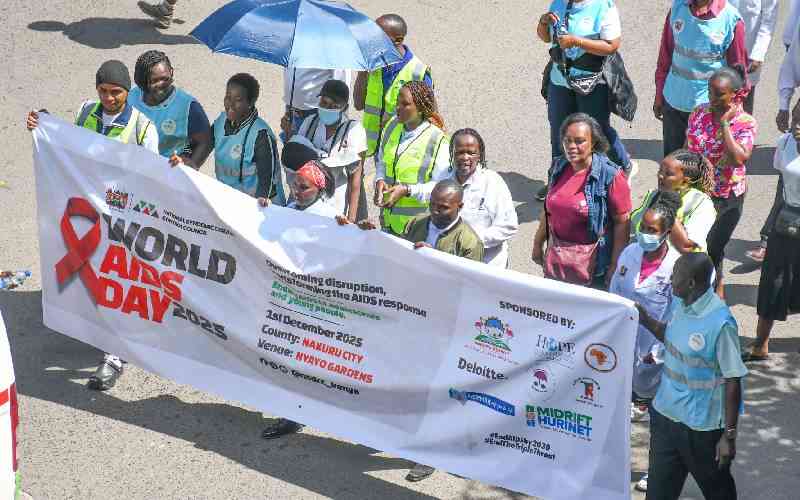
Participants march along Kenyatta Avenue in Nakuru during celebrations for World Aids Day on December 1, 2025. [Kipsang Joseph, Standard]
At least three in every 10 babies born in Wajir acquire HIV at birth, at a rate of 33.4 per cent, placing the arid and semi-arid counties among the hardest hit.
Data from the National Syndemic Disease Control Council (NSDCC) shows that five other counties recorded mother-to-child HIV transmission rates above 20 per cent in 2024. They are Isiolo (27.5 per cent), Samburu (26 per cent), Baringo (22.5 per cent), Marsabit (19.9 per cent) and Kilifi (19.6 per cent).
Other counties with high infection rates above 18 per cent, include Tana River, Elgeyo Marakwet, Meru, Bungoma, Nyamira and Kwale. These infections surpass the national rate of 9.3 per cent, although it had decreased from 10.8 per cent recorded in 2019.
“While HIV mother-to-child transmission rates have declined over time, the national target remains unmet, with an increase recorded in the past year to 9.3 per cent,” states NSDCC.
The rise reflects persistent gaps in prevention, including missed antenatal care (ANC) visits, poor ART adherence, and delays in early infant diagnosis and treatment. At least 83 per cent of pregnant women attended a first ANC visit, leaving many without access to a critical entry point for maternal and child health services. Over two-thirds of infant infections are linked to ART non-use or drop-off, underscoring the need for stronger follow-up, adherence support, and service integration.
Notable declines in HIV were observed in high-burden counties, such as Homa Bay, Siaya and Kisumu, where mother-to-child transmission rates fell by more than three percentage points. Other counties with reduced cases, include Kirinyaga, Nyeri, Migori, Machakos, Kakamega and Lamu, largely due tostronger programme performanceand retention in care.
Even as Kenya moves towards ending HIV/AIDS by 2030, the country continues to face a substantial HIV burden, with an estimated 1,326,336 people living with the disease by 2024. The majority (1,263,538) are aged 15 years and above, while children aged zero to 14 account for 62,798.
The 2024 distribution of new HIV infections reveals persistent age and gender disparities, with adolescent girls and young women disproportionately affected, highlighting the need for targeted prevention. Overall, new HIV infections declined by 52 per cent between 2019 (41,416) and 2024 (19,991), but the past year recorded a 19 per cent increase, rising from 16,752 in 2023 to 19,991 in 2024. Children remain particularly vulnerable, accounting for 22 per cent of all new infections, indicating the urgent need to strengthen the prevention of mother-to-child transmission (PMTCT) programme.
Viral suppression is yet to be fully attained. “Kenya continues to make progress in HIV testing, though challenges persist in treatment continuity and viral suppression,” states the NSDCC. Knowledge of HIV status increased from 93 per cent in 2019 to 97 per cent in 2024, and ART coverage rose from 77 per cent to 87.7 per cent, though below the 95 per cent target.
Minimal gains among children stood at 75.1 per cent, up from 73 per cent.Viral suppression decreasedfrom 85 per cent in 2019 to 83 per cent in 2024, reflecting challenges in adherence and retention. In 2024, about three per cent of people on treatment experienced interruptions, with the highest rates among men.
Subscribe to our newsletter and stay updated on the latest developments and special
offers!