
EXPLAINER: Why Military Vehicles Do Not Use Standard Civilian Number Plates
Source: Kenyans.co.ke
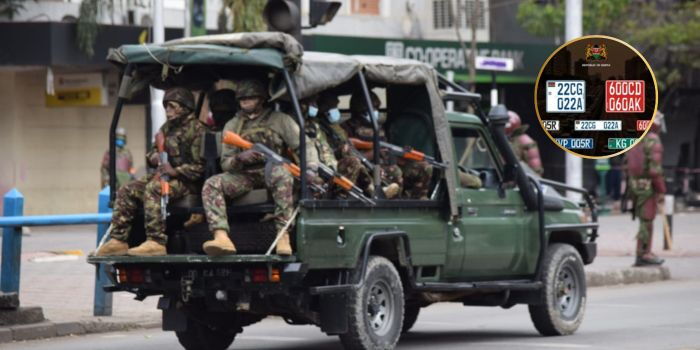
Military vehicles often operate without the standard registration plates seen on civilian cars across the world.
In Kenya, as in many other countries, this practice is rooted in operational security, tactical necessity and administrative protocol.
In Kenya, these factors override the legal requirements set by regulatory bodies such as the National Transport and Safety Authority (NTSA) for the identification of motor vehicles.
One of the primary reasons for avoiding standard number plates is security. Military vehicles often carry sensitive equipment, essential personnel or high-ranking officials.
Displaying a visible, traceable number plate can reveal critical information about the vehicle’s origin, unit or purpose, which could expose troops or operations to threats.
For instance, during counter-terrorism operations in sensitive regions or border patrols, Kenya Defence Forces (KDF) units operate without civilian licence plates to prevent adversaries from tracking their movements and gathering intelligence.
Vehicles assigned to VIP protection, presidential escorts or rapid deployment teams also use discreet markings instead of full number plates.
In hostile or rough terrain, plates can easily be lost or removed by environmental factors or hostile actors. This is why internal registrations are inscribed directly onto the metal body.
Vehicles without visible plates reduce the chance that information about troop movements, unit types or high-value assets can be inferred by hostile parties.
In Kenya military vehicles operate under the direct authority of the Ministry of Defence and the KDF.
They are generally exempt from many civilian traffic laws and standard licensing requirements, signifying their unique legal standing.
Thisunique military numbering signifies sovereign immunityand a difference in jurisdiction.
The non-standard numbering system immediately identifies which branch of the KDF the vehicle belongs to, a crucial element for internal military logistics, maintenance, and command structure.
The format typically uses an abbreviation followed by numbers, all usually painted directly onto the vehicle body in low-visibility colours.
In tactical or operational environments, large, reflective civilian number plates are a liability.
Standard plates are highly visible, which compromises tactical camouflage.
Military identification numbers are instead painted in a low-visibility colour, such as matte white or black, that blends with the vehicle’s camouflage scheme (like olive green or desert tan). This ensures tactical concealment.
Furthermore, military vehicles are subjected to extreme conditions in combat or rough terrain, where a standard aluminium or plastic number plate could easily be lost or damaged.
Painting the registration directly onto the metal body ensures the identification remains visible and durable regardless of operational stress.
Military vehicles are recorded in specialised internal defence registries rather than the public motor vehicle databases.
This allows the armed forces to monitor and maintain their fleet without exposing operational details to public scrutiny.
Most military forcesworldwide do not use civilian registration platesbut rather an internal or tactical numbering system.
Kenya's system aligns with this global standard, particularly for vehicles used in joint missions, training exercises, or regional deployments where immediate identification of a vehicle as ‘military’ is critical.
For instance, NATO forces and allied militaries employ special formats to maintain discretion.
Units often display insignia, flags, or tactical markings, enabling personnel to recognise vehicles and ensuring accountability within the force without compromising public security.
During high-profile national events and holidays, such as the presidential Land Cruiser, the vehicle often bears the C–in–C plate, signifying it belongs to the Commander-in-Chief, offering a ceremonial identification in place of a standard plate.
The military vehicle identification system, therefore, is a carefully managed balance that prioritises national security, operational effectiveness, and internal accountability over civilian registration formality.